

Traditional onboarding is sending users a video they never watch, documentation they never read, and a product tour they close before it even starts. Agentic onboarding is different: it’s a personalized experience that gives each user exactly what they need, when they need it - and doesn’t waste time telling them what they’ve already figured out.
Most onboarding tools already automate sending. Agentic onboarding automates the judgment - what to send, to whom, when.
Two Halves of Onboarding: Outside the Product vs. Inside It
Onboarding splits into two categories, and agents help differently in each.
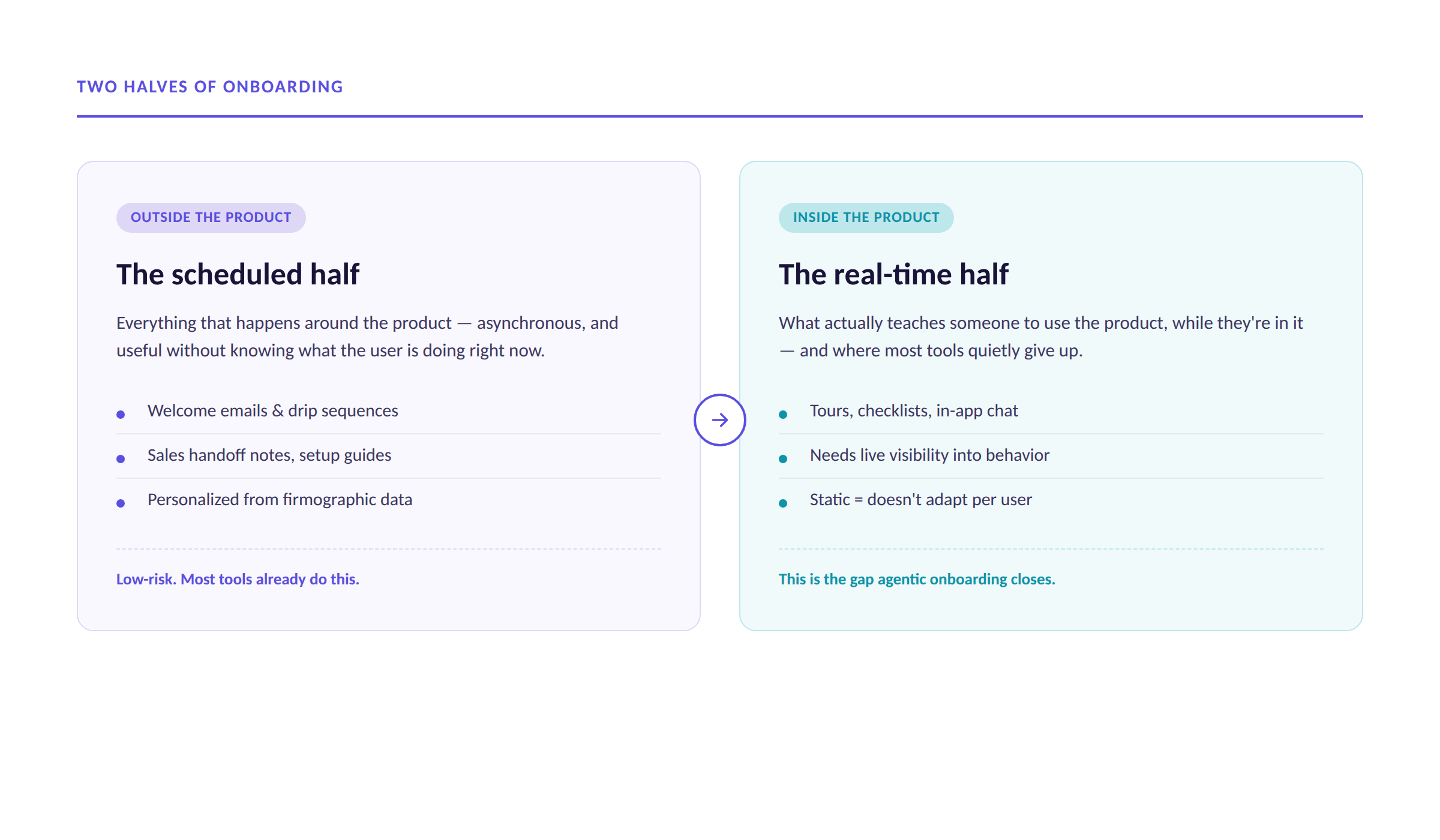
Outside the product - welcome emails, drip sequences, sales handoff notes, setup guides.
Asynchronous and scheduled
Doesn’t need to know what the user is doing right now
Easy to delegate - agents can draft, sequence, and personalize it from data collected between sessions
Low-risk, and most tools already do a version of it
Inside the product - the part that actually teaches someone to use the product while they’re in it. This is where most tools quietly give up.
Some products drop users in with zero guidance
Others front-load a tour, checklist, or wizard
Both are static - they don’t adapt to what this user is doing, has figured out, or is stuck on
That static gap is what agentic onboarding closes.
Why In-Product Onboarding Has to Be Real-Time
A tour doesn’t know you’ve already used the feature it’s explaining. A checklist doesn’t know you’re stuck on step 4, not step 2. A chatbot doesn’t know anything happened unless you go ask it.
In-product guidance only works if it’s built on what the user is doing right now:
What they clicked
What they skipped
Where they paused
What they haven’t touched yet
Without that live visibility, “in-product onboarding” is just a script with better timing. Sending the right email at the right time is solved. Catching a user about to give up on a feature they haven’t found - before they do - is not.
How Agentic Onboarding Actually Works
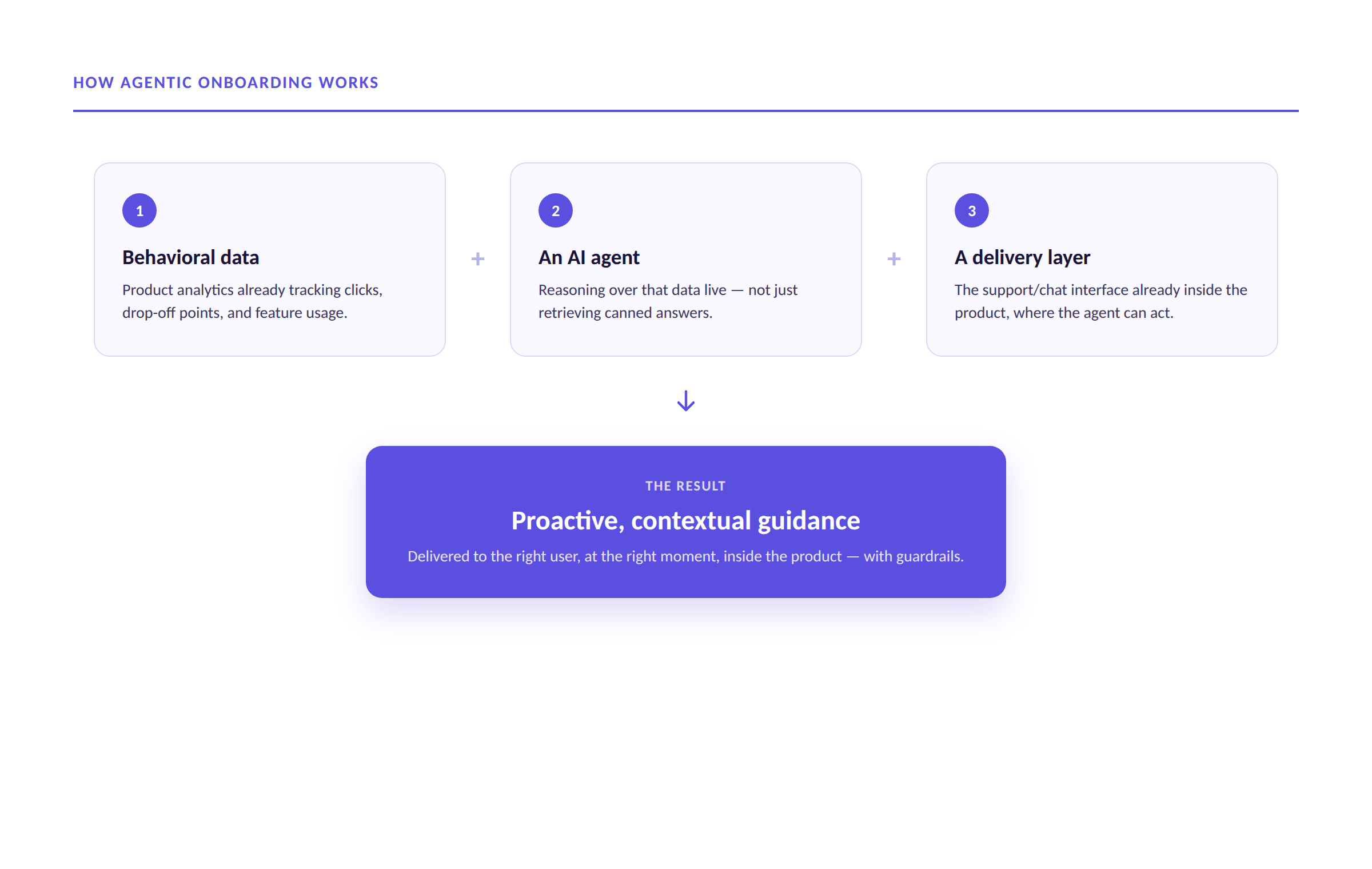
Give the agent the right context, and let it act on it. That means connecting three things that usually live in separate tools:
Behavioral data - from product analytics already tracking clicks, drop-off, feature usage
An AI agent - reasoning over that data live, not retrieving canned answers
A delivery layer - the support/chat interface already in the product, where the agent can act
Most teams already have #1 and #3. What’s missing is the connective tissue - a way for behavioral signal to reach the agent mid-session, so it can decide what to say and when.
That connective layer is the actual unlock. Not a smarter chatbot. Not another tour builder.
It also scales better than static rules ever could. A checklist can react to one or two conditions before it’s unmanageable to maintain. An agent can weigh a user’s full behavioral history, plan tier, what they’ve mastered, what similar users struggled with, and their last five actions - all at once - to pick the single next best move.
Why Delegate Onboarding to an Agent at All?
Because the current system burns the wrong kind of time.
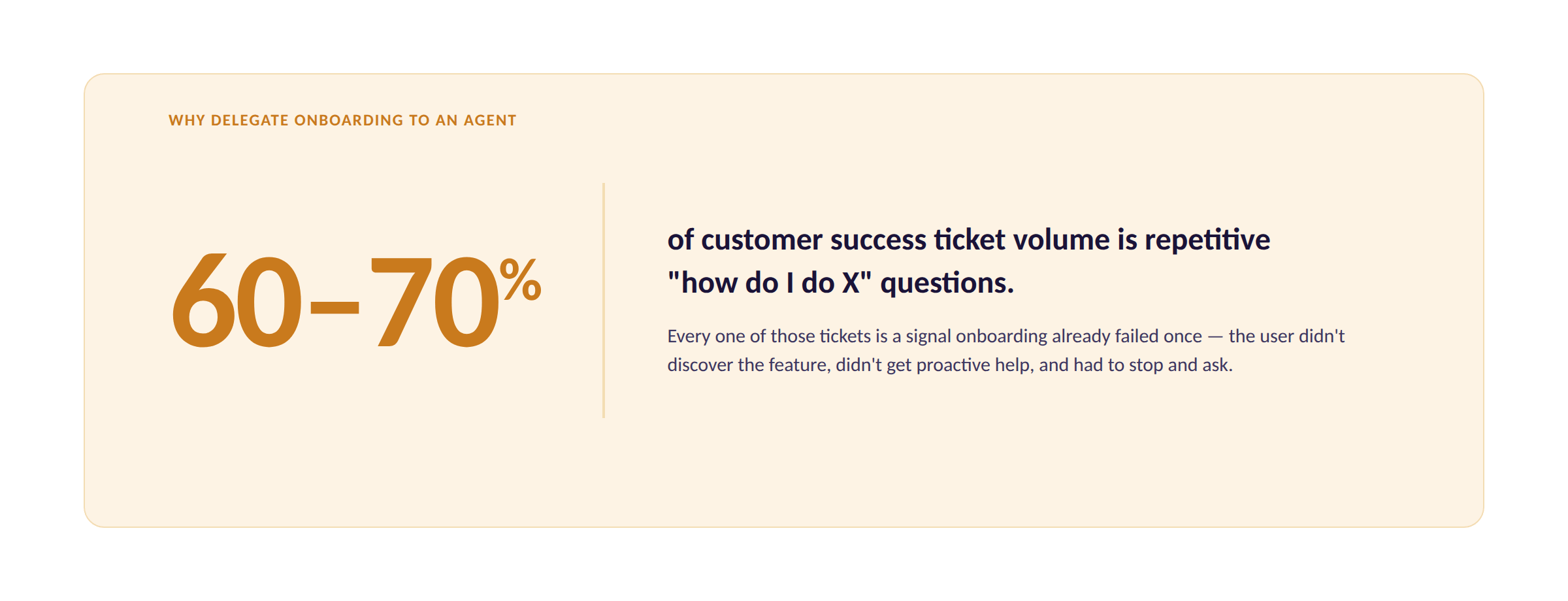
60–70% of customer success ticket volume is repetitive “how do I do X” questions
That’s not relationship-building or strategic work - it’s the same answer, given by a human, over and over
Every one of those tickets is a signal onboarding already failed once: the user didn’t discover the feature, didn’t get proactive help, had to stop and ask
Delegating the teaching layer isn’t about replacing CS - it’s giving them their time back for the work that actually protects and grows revenue: expansion signals, renewal risk, account strategy. That’s commercial work. Explaining where a button is, is not.
Why Should You Build an Onboarding Agent?
It’s not the right investment at every stage. But it starts to make sense once these show up together:
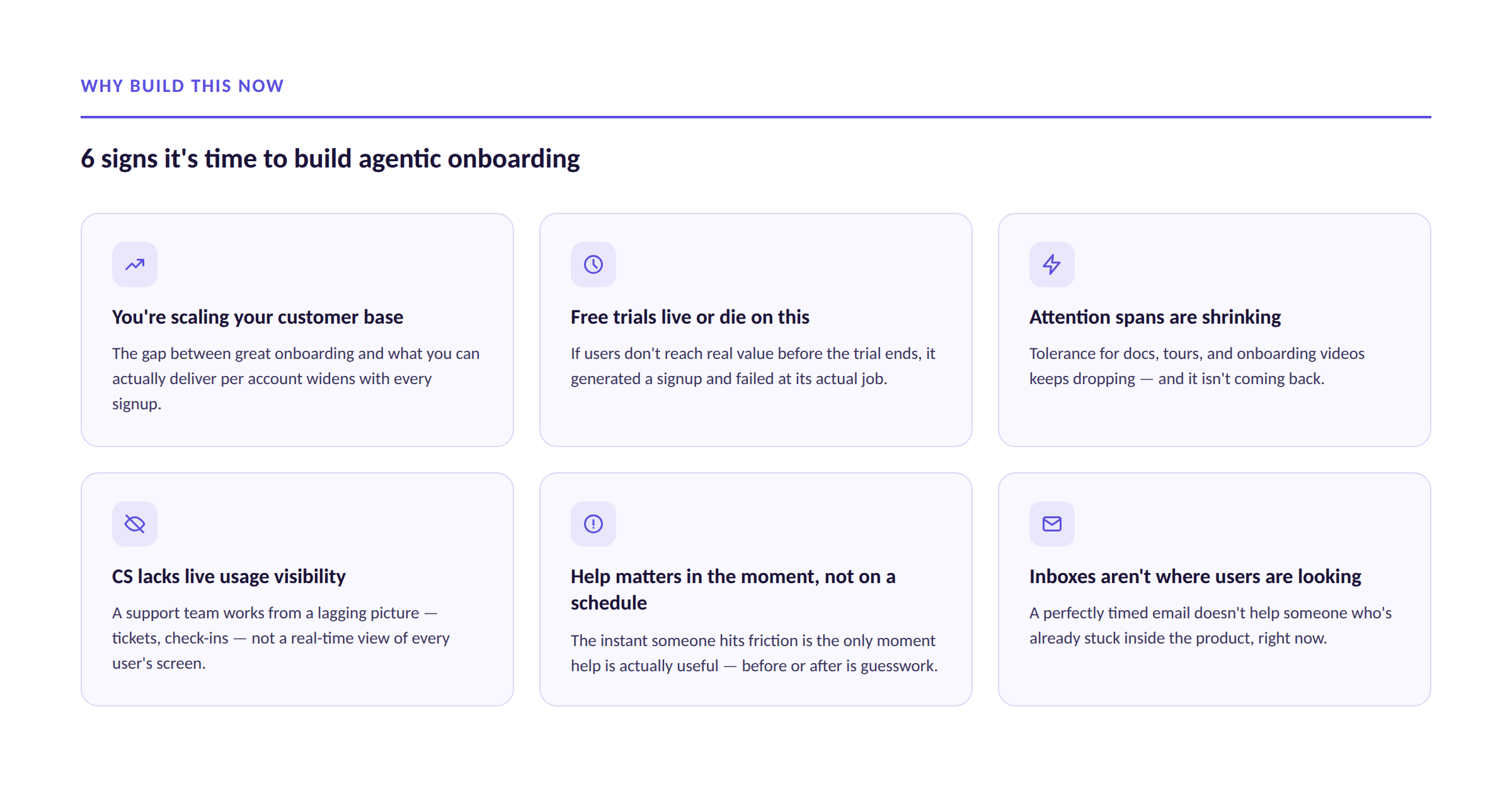
You’re scaling. The gap between great onboarding and what you can deliver per account widens with every signup.
Free trials live or die on it. If users don’t reach real value before the trial ends, it generated a signup and failed at its actual job.
Attention spans are shrinking. Tolerance for docs, tours, and videos keeps dropping - permanently.
CS has no live visibility. They’re working from tickets and check-ins, not a real-time view of usage.
Help only works in the moment. The instant someone hits friction is the only moment help is useful - before or after is guesswork.
Inboxes aren’t where users are looking. A perfectly timed email doesn’t help someone stuck inside the product right now.
These aren’t six separate arguments - they’re one: user volume, the speed users need to succeed, and their shrinking attention have all outpaced manual - or even scripted - onboarding.
What Shouldn’t Be Delegated
Agentic onboarding is a lever, not a philosophy. Keep these human:
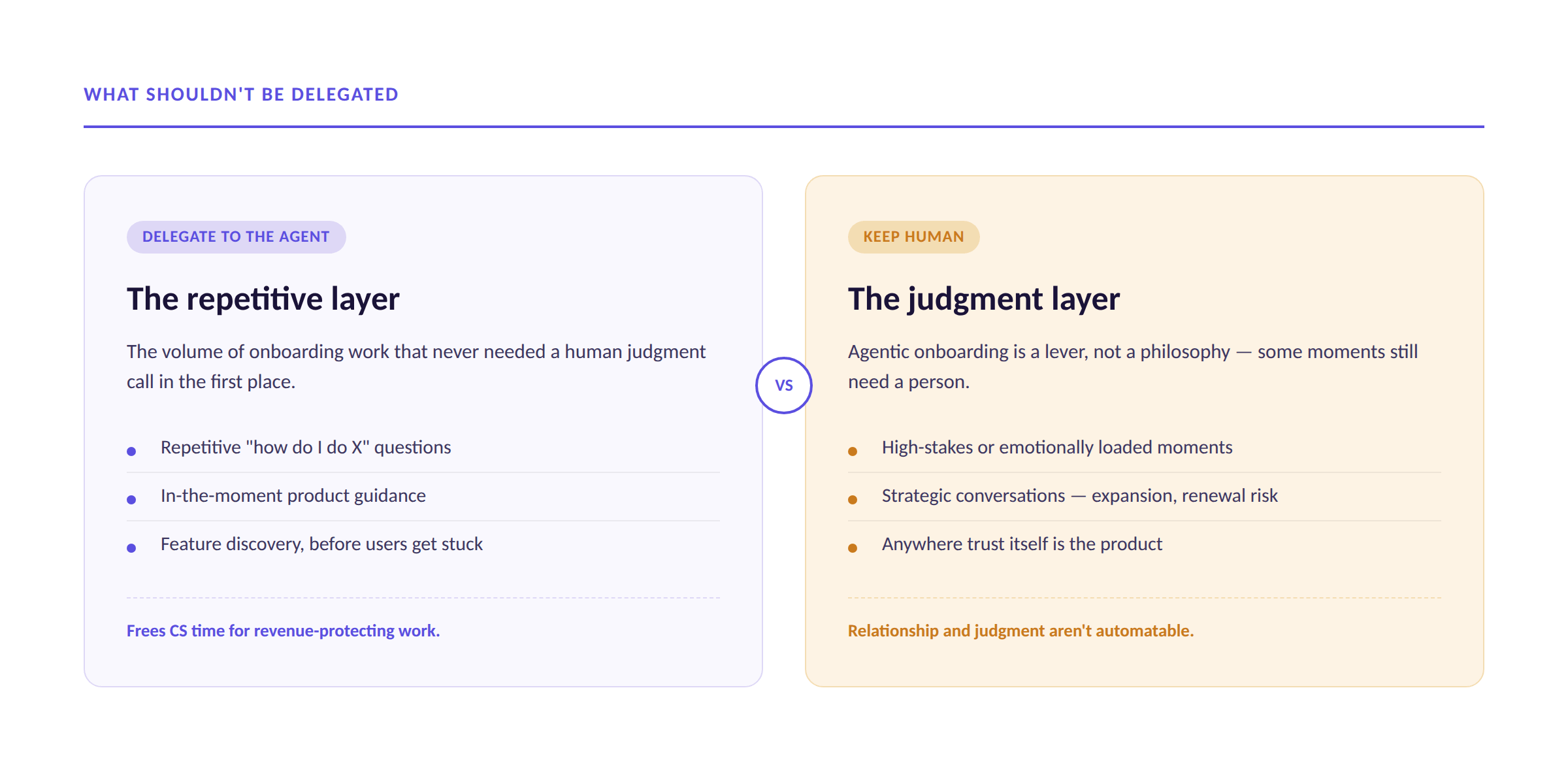
High-stakes or emotionally loaded moments - a frustrated enterprise customer mid-escalation doesn’t want a bot deciding what happens next
Strategic or commercial conversations - expansion, renewal risk, account strategy need a person who understands the relationship
Anything where trust is the product - in regulated or high-touch industries, the first human interaction can matter more than the fastest one
The goal isn’t removing humans from onboarding. It’s freeing their time from the parts that never needed a human, for the parts that do.
Agentic Onboarding: FAQ
Is this the same as a chatbot? No. A chatbot answers when asked. Agentic onboarding proactively decides what a user needs based on real-time behavior - often before they know they need help.
Do I need to replace my existing tools? Usually not. Most teams already have the behavioral data and a support/chat interface. Agentic onboarding connects the two.
Is this only for complex products? It’s most valuable where users get stuck silently - which correlates with complexity but isn’t limited to it. Simple products with low feature discovery benefit too.
Does this replace customer success? No. It removes the repetitive, low-value “how do I use this” volume, freeing CS for higher-value, revenue-protecting work.