

What grows to fill the space is more commercial - managing risk, driving expansion, and increasingly, managing the agent that’s now doing the teaching. Not a subtraction. A role shift, on both sides.
The Core Shift: From Product Teacher to Business Partner
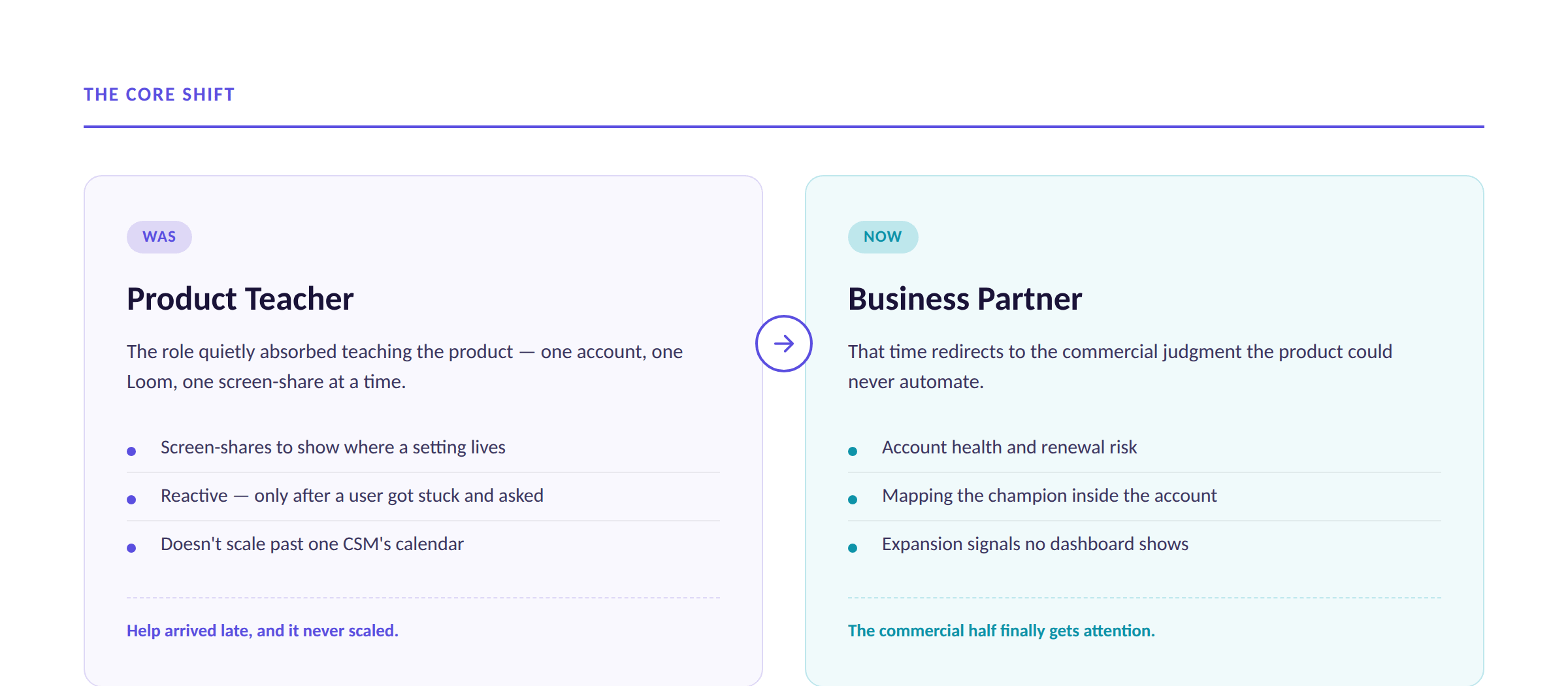
A meaningful share of every CS conversation has quietly been product teaching in disguise - a user books time with their CSM not for a relationship check-in, but because they’re stuck on something the product should’ve made obvious.
The tell: screen-sharing. A call to show where a setting lives, a Loom walking through a feature - product education done manually, by someone whose real value is commercial judgment.
It’s reactive. Help only comes when a user finally asks, not the moment they get stuck. It arrives late, and it doesn’t scale past one CSM’s calendar.
An agent fixes the timing. Give it live context on a user’s actual progress, and that whole category of conversation mostly disappears - handled in real time, inside the product.
What’s left for CS isn’t “did this person learn the product.” It’s the questions that always mattered more: Is this account healthy? Is there a champion who’ll fight for renewal? Is there risk a usage dashboard won’t show? Is there expansion we haven’t surfaced?
What Time Actually Gets Freed Up
Worth being honest about what this time was going to - it wasn’t strategic.
The same “how do I set this up” questions, asked by different people, forever
No judgment required, no account history, no commercial context — just product knowledge
Exactly the kind of knowledge an agent holds consistently, at any hour, for any number of users at once
What Fills That Time: Higher-ROI, More Commercial Work
Freed-up time doesn’t sit empty. It moves to the work that was always more valuable and always harder to get to:
What an account is planning, what else they’re evaluating
Where the relationship could expand
Who inside the account will actually champion renewal
This is customer success in the fullest sense - and it scales worst when a CSM doubles as the help desk. Remove the help-desk half, and the commercial half finally gets the attention it needed.
The New Responsibility: Managing the Agent
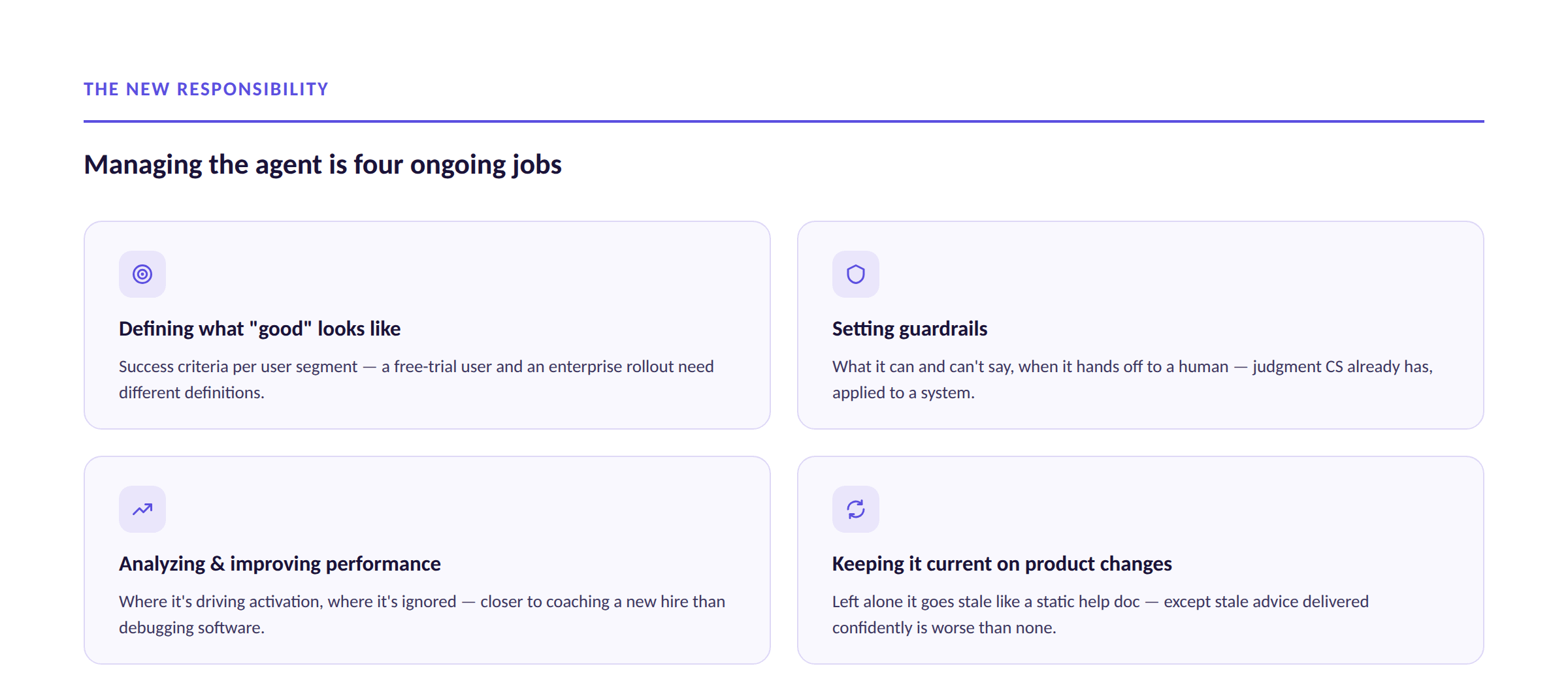
Delegating onboarding isn’t a one-time handoff. Someone defines what “good” looks like, and someone checks the agent is actually delivering it. Four ongoing jobs:
Define “good” - and for whom. A free-trial user needs something different than an enterprise admin rolling out to 200 people. Success criteria per segment, not one objective for everyone.
Set guardrails. What it can and can’t say, when it hands off to a human, where it stays conservative instead of confidently wrong - judgment CS already has, applied to a system.
Analyze and improve performance. Where it’s driving activation, where it’s ignored, where the advice technically works but reads badly. Closer to coaching a new hire than debugging software.
Keep it current. When a feature ships or changes, someone tells the agent where things live now. Left alone, it goes stale like a static help doc - except confident, stale advice is worse than none.
That work sits with CS, not engineering or product - they’re the team that knows what a good outcome looks like. Part of the role starts to look less like “answering tickets,” more like “managing a teammate.”
The Role, Restated
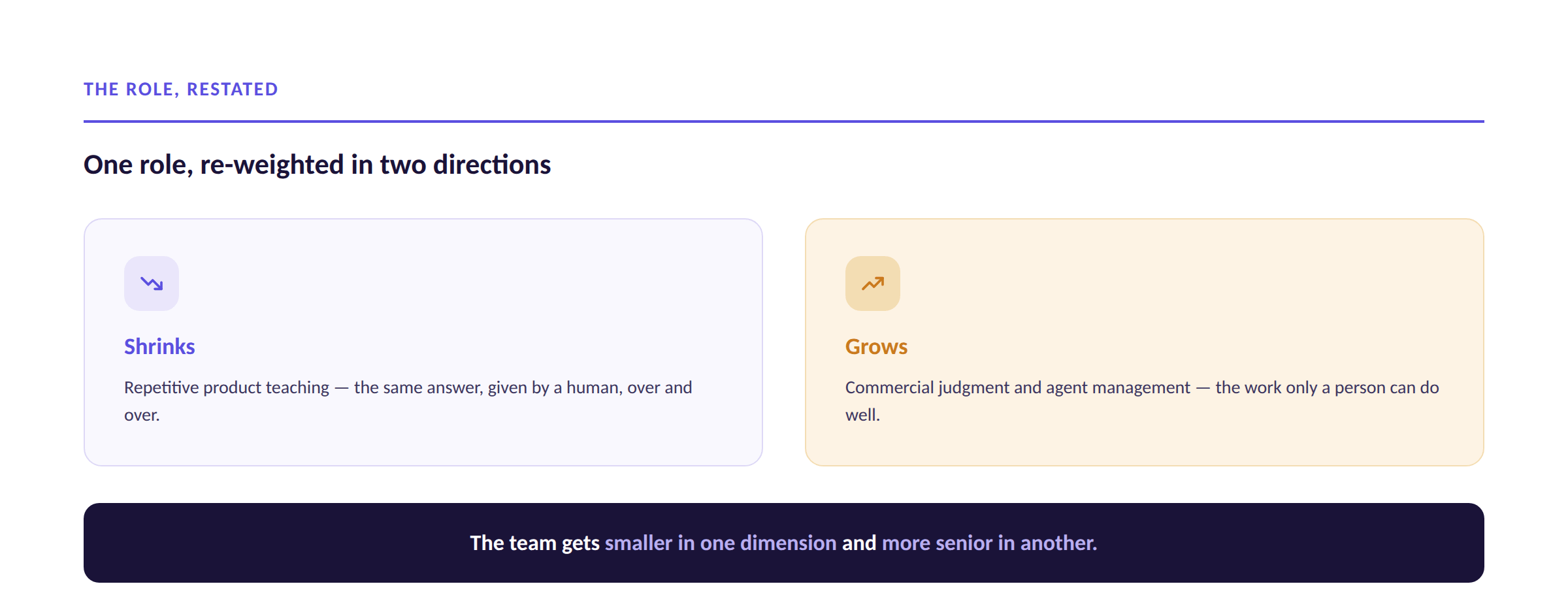
Agentic onboarding doesn’t shrink customer success - it re-weights it. Away from repetitive product teaching, toward the commercial judgment that protects and grows revenue, plus a new layer of responsibility for managing the agent now doing the teaching.
The team gets smaller in one dimension and more senior in another.
Agentic Onboarding & the CS Role: FAQ
Does this mean fewer customer success roles? Not fewer - different. The repetitive work shrinks; the commercial and agent-management work that replaces it needs more experience, not less.
Who’s responsible for the onboarding agent once it’s live? Increasingly, CS - they’re best positioned to define a good outcome and catch it when the agent gets something wrong.
Does this change what skills CS hires need? Over time, yes. Product knowledge still matters, but commercial judgment and comfort managing an AI system become more central.
Is this just CS becoming “more technical”? Not exactly. Less writing code, more defining objectives, reviewing outcomes, and knowing when to step in - closer to managing a junior teammate than an engineering skill.