

Agent-Led Growth — Issue 03
Onboarding was designed for a world where the only way to learn a product was to look at it.
Tooltips. Checklists. Tours. All of it assumes a user clicking through a UI, one screen at a time, following a path someone else laid out in advance.
That assumption is dissolving. Not because tooltips got worse — because the way people expect to interact with software changed underneath them.
Five shifts are driving it. Each one is backed by data, not vibes.
1. People want whichever is faster — chat or click
Conversational interfaces have gone from support-widget afterthought to a default way of using a product. That doesn’t mean chat is replacing the UI. It means users are impatient with whichever option is slower in the moment, and expect to move between both without friction.
The conversational AI market is estimated at $17–19 billion in 2026, growing more than 20% a year across most forecasts — Azumo
Close to 1 billion people worldwide were already using AI chatbots as of 2025 — Azumo
85% of customer service leaders said they’d explore or pilot customer-facing conversational GenAI in 2025 — Gartner
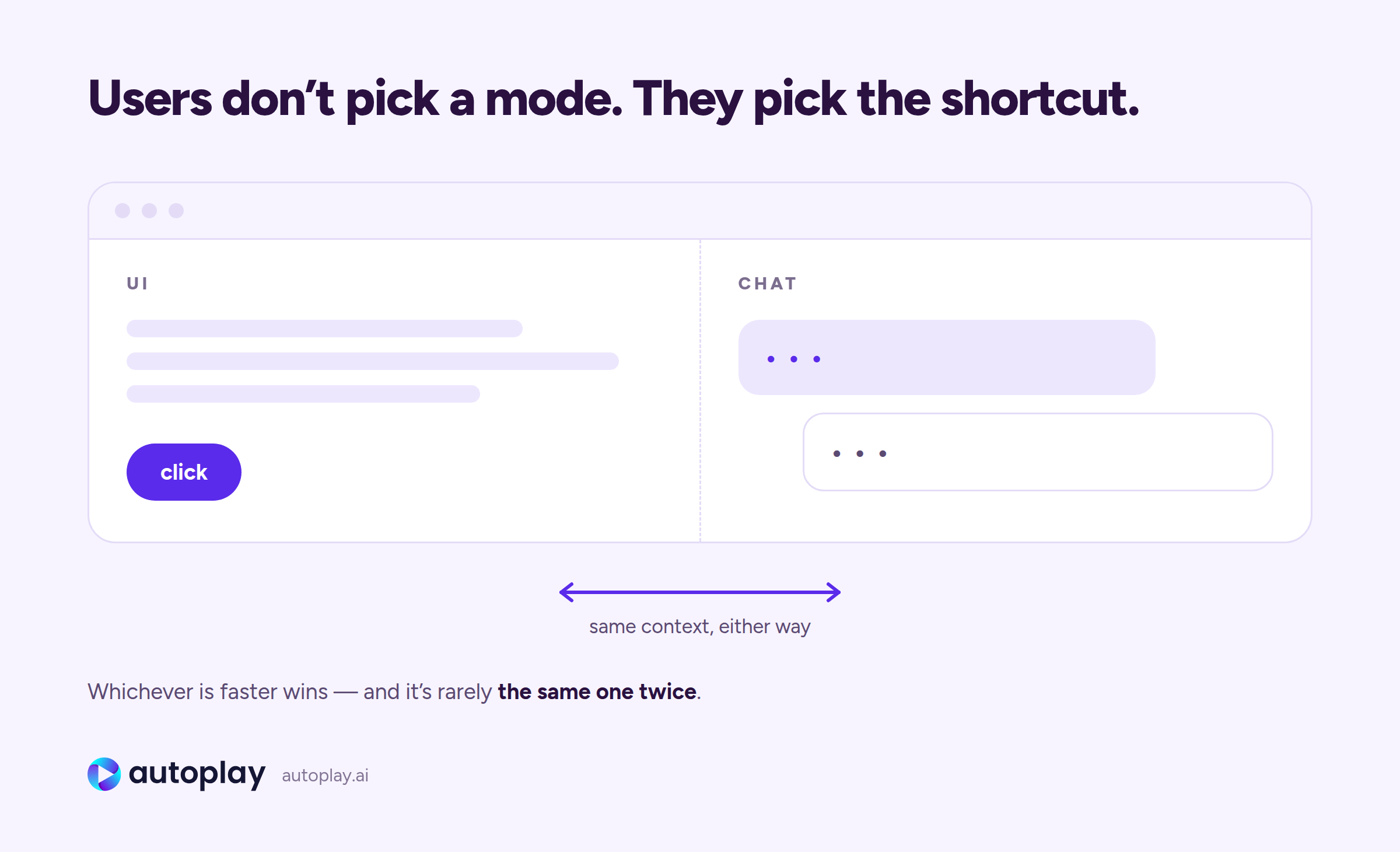
The practical effect: some users type, some click, and most do both in the same session depending on which gets them there faster.
Onboarding built entirely as a silent, click-only UI layer — or entirely as a chat-only flow — optimizes for one preference at the expense of the other. Neither is what users actually want. What they want is to never have to think about which mode they’re in.
2. Software is going hybrid, and the personalization bar went up with it
The Model Context Protocol is the infrastructure story behind this shift.
MCP went from roughly 100,000 SDK downloads in its first month to about 97 million monthly by March 2026 — a ~970x increase in eighteen months — Knak
What that enables in practice: a chat agent and a visual interface sharing the same context, instead of running as two disconnected systems. The agent can see what’s on screen. The UI can respond to what was just said.
That hybrid model only works if what sits underneath it is personalized — and the demand for that is well documented well outside software:
71% of consumers expect personalized interactions and 76% are frustrated when a company fails to deliver one. Faster-growing companies drive 40% more revenue from personalization than slower-growing peers — McKinsey
80% of US consumers are more likely to purchase when brands offer personalized experiences — Deloitte Digital / Meta
Onboarding isn’t exempt from that expectation. A generic five-step tour, shown identically to every signup, is now the exception users tolerate — not the standard they expect.
3. AI remembers now, and users expect it to
ChatGPT, Gemini and most major AI assistants have shipped some form of persistent memory over the past year — carrying context from one interaction into the next instead of starting cold every time.
85% of CX leaders say memory-rich AI is critical to genuinely personalized customer journeys
81% of consumers want an agent to pick up where a previous conversation left off
74% get frustrated when they have to repeat information they’ve already given
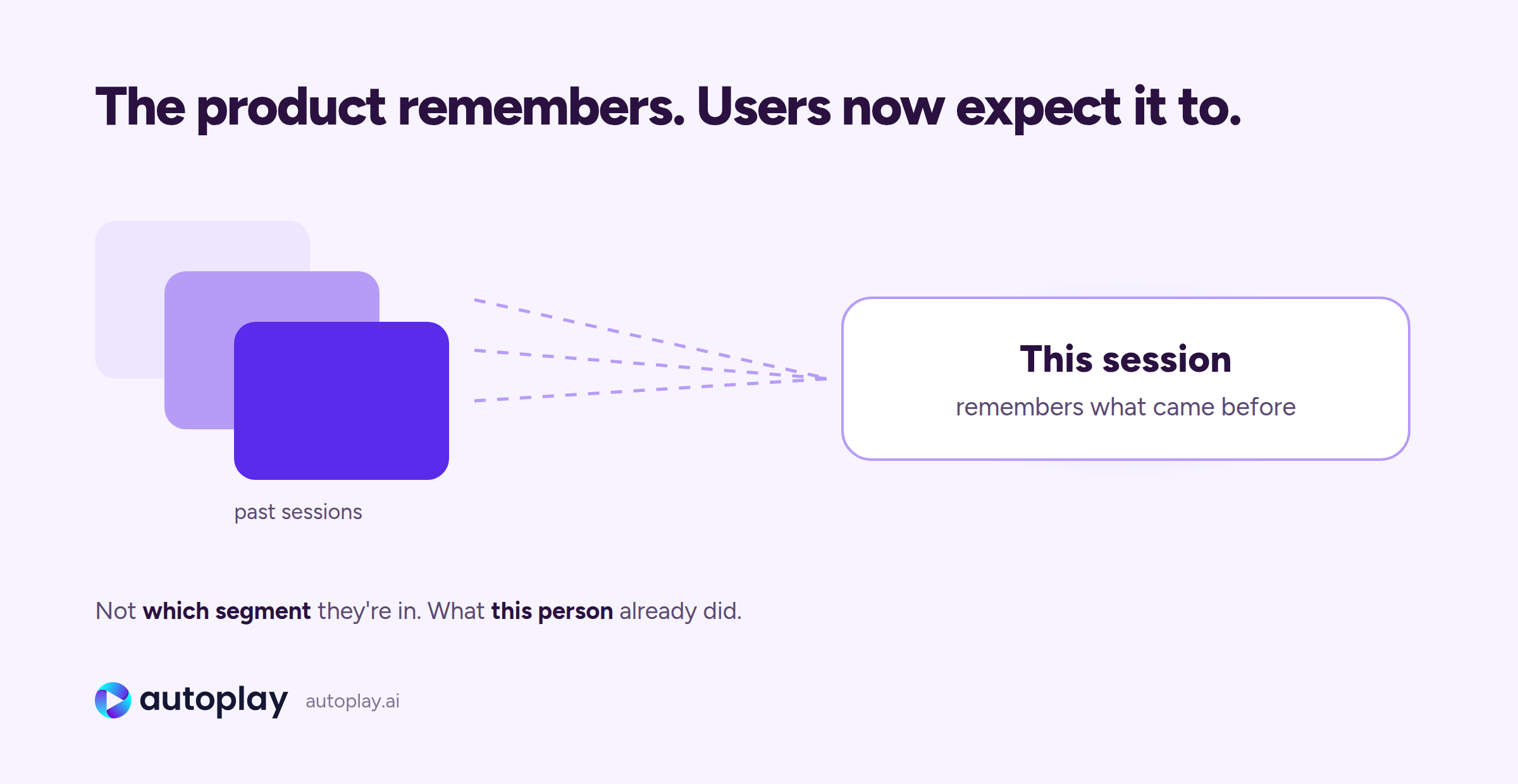
For onboarding, this changes what “personalized” can mean at all.
It’s no longer which persona segment is this user in. It’s what has this specific user already done, what did they ask last time, and what do they still need — carried forward automatically, instead of re-derived every session or re-explained by the user every time they open a support chat.
4. Attention is shrinking, and AI is partly why
This one cuts against the other three. Even as expectations for depth and personalization rise, patience for getting to the point keeps falling.
Gloria Mark’s research at UC Irvine — one of the longest-running studies of attention on digital devices — tracked the decline:
~2.5 minutes average sustained attention on a screen, early 2000s
~75 seconds by 2012
Under 60 seconds in more recent measurements
— UC Irvine Informatics · recent coverage
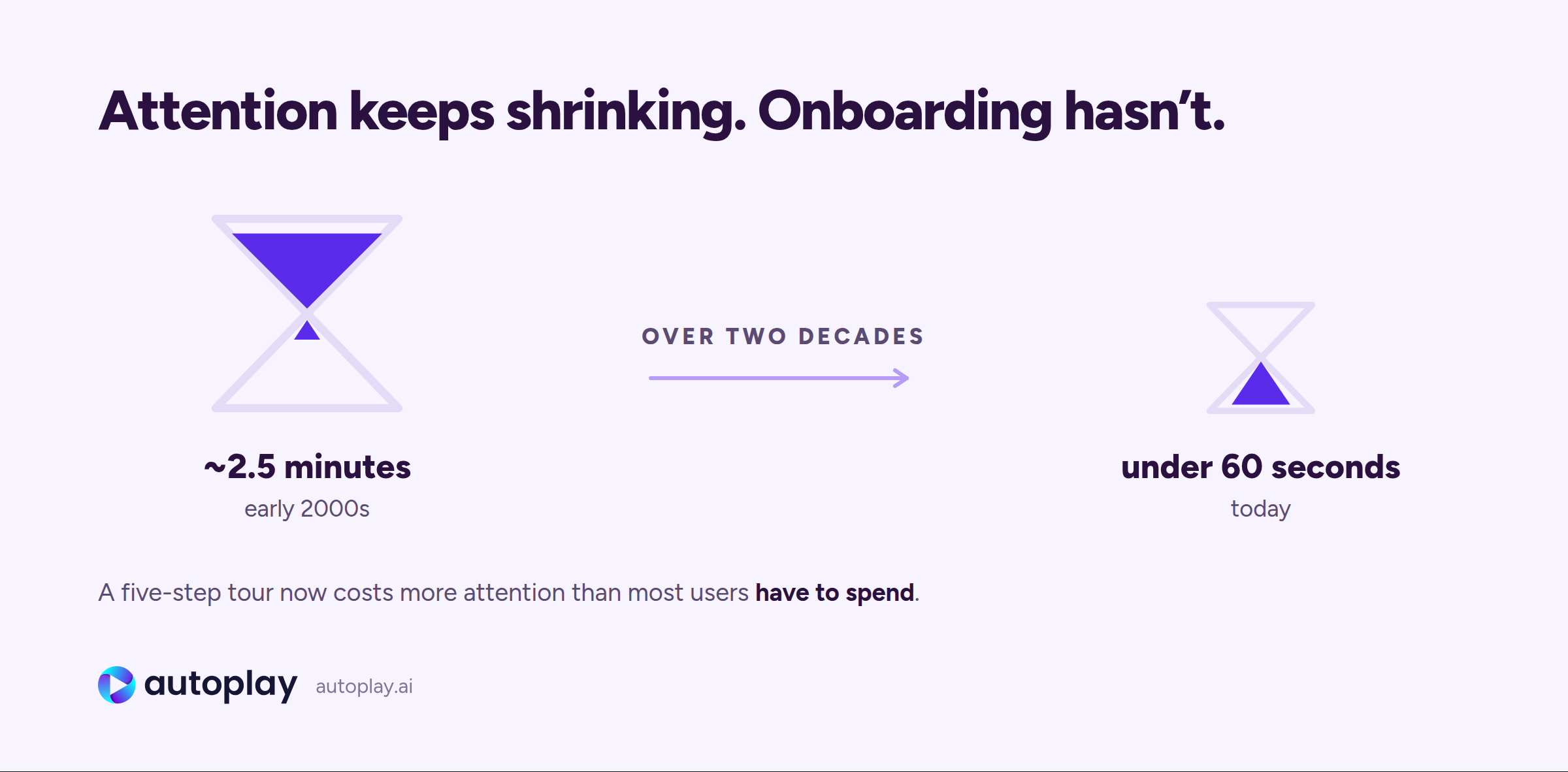
Part of what’s driving that compression is AI itself. When an assistant answers a question or completes a task in seconds, a five-step tour that used to feel like a reasonable investment now reads as friction.
Users want the outcome, not the walkthrough — a preference AI trained into them everywhere else, then carried straight into how they judge your product on day one.
5. And underneath it all: the adoption problem SaaS never solved
Here’s the part that doesn’t get said enough. Full-platform adoption — getting users to actually find and use what’s been built, not just the two or three features they stumbled into on day one — has been unsolved for as long as SaaS has existed. Not for lack of trying.
80% of features in the average software product are rarely or never used, per Pendo’s research across hundreds of customer accounts
Public cloud software companies have collectively sunk an estimated $29.5 billion in R&D into features that then go largely untouched
— Pendo, Feature Adoption Report
Tooltips, checklists and release-note emails have been the industry’s answer for over a decade. The numbers above are what that answer produced.
It isn’t a discovery problem a better changelog fixes. It’s that nobody has had a scalable way to say the right thing to the right user at the right moment, for every feature, continuously — instead of once at signup.
That’s exactly what a hybrid, memory-aware, always-available agent is positioned to do differently. Not just at onboarding, but for the life of the account. The four shifts changing what a new user expects in week one are the same four that make it possible to keep surfacing value in month six and month twelve.
What This Means for How Onboarding Gets Built
Put together, the five shifts point the same way:
Users want the fastest path to an answer, whether that’s a click or a prompt — not a forced choice between them
Chat and UI have to share context, not operate as two systems that happen to sit on the same page
They expect the product to remember them, not just segment them
They have less patience than ever for a static path built with none of the above in mind
And the real prize is bigger than onboarding — most of what gets built never gets used, and this shift is a genuine opportunity to fix it
Onboarding stopped being a flow you design once. It’s becoming a system that reads context and decides what to say next — and it doesn’t stop at day one.
Onboarding in the Era of AI: FAQ
Is chat replacing onboarding UI? No. Users move between both within a single session and pick whichever is faster for the task in front of them. The failure mode is forcing one mode on everyone, in either direction.
What makes onboarding “AI-native” rather than just having a chatbot? Shared context. The agent can see what’s on screen and what the user has already done; the UI reflects what the agent just did. A chatbot parked in the corner of an app has neither.
Why does AI memory matter for onboarding specifically? It changes what personalization means — from which segment a user belongs to, to what this particular person has already completed, asked about, or skipped. That’s the difference between a tailored path and a persona-shaped tour.
Do shorter attention spans mean onboarding should just be shorter? Not shorter — more targeted. The problem isn’t length, it’s spending a user’s limited attention on steps they don’t need.
What does this have to do with feature adoption? The same capabilities that get a user to first value in week one — live context, memory, an agent that’s always there — are what let you keep surfacing relevant features in month six. Onboarding and adoption stop being separate problems.
Want to see this working on your own product? autoplay.ai · Quickstart docs: developers.autoplay.ai